EXPLORE
Behind the scenes—From Stage to Page
Behind the scenes—The Making of this Book
Author Program—The Magic, Mystery, and History of Shakespeare's First Folio


-
JULIET. MACBETH. HAMLET.
WILLIAM SHAKESPEARE HIMSELF.
FAMILIAR NAMES TO BE SURE, BUT WHY?
How is it that anyone recognizes these centuries-old names at all? The main reason is a book. A four hundred-year-old book known as the First Folio. A fact that just begs more questions, doesn't it? Who created the First Folio? How was it made? And how has it survived for so long?
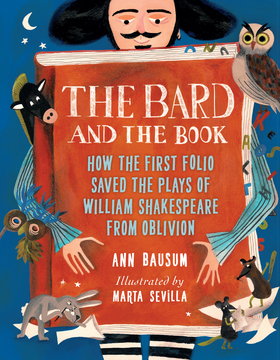
The Bard and the Book: How the First Folio Saved the Plays of William Shakespeare from Oblivion provides the answers by sharing the unlikely true story of why Shakespeare and his incomparable plays weren't lost to history after his death, and how it's possible that we still know them today. Ann Bausum's behind-the-scenes, sharply funny, and meticulously researched narrative makes an ideal introduction to the Bard and some of his most enduring works.
-
This book began, appropriately enough, with a play, although it was not one written by William Shakespeare. I remain in the debt of Lauren Gunderson, playwright of The Book of Will, for introducing me to the story of the First Folio. I must simultaneously acknowledge my favorite company of actors, the American Players Theatre of Spring Green, Wisconsin, who staged an irresistible production of Ms. Gunderson's play during 2019. I attended the show three times in the space of a few weeks, driving nearly four hours round-trip on each occasion for the joy of the experience.
I already counted myself as something of a Shakespeare-aficionado, having known about and enjoyed his plays since, well, forever! But this First Folio business was a new twist for me. Could it actually be true? Was there really that much drama behind the gathering of so much drama? The more I learned, the more I wanted to know, and that curiosity took me before the year was out to the Folger Shakespeare Library in Washington, DC.
Although my experiences at the Folger were limited to the span of a week, they enriched my work for the duration of this project. In addition to this hands-on archival work, I read numerous books about Shakespeare's life, his literature, and the First Folio itself. Throughout the process I drew on my love of Shakespeare's plays, his joy in language, and my delight in a lifetime of intersections with them both.
The end result is meant to share my thrill of discovery with all readers through The Bard and The Book.
You can read more about the origin story for this book at my blog post for the American Players Theatre. Here's a link.
-
The Bard and the Book is all about the making of a book. In order to share that history, my publisher and I made a book of our own. Many hands around the globe and a variety of machines helped with that work. Despite the passage of time, the steps in that process share remarkable similarities—as well as some notable differences—with those behind the creation of the First Folio. Read on and see for yourself.
The original text for this book was composed electronically by the author at her home in Wisconsin using Microsoft Word. No backward letters required, thankfully! People in locations across the United States, including New York City, Atlanta, and New Orleans, helped the text become a book. Creative Director Kerry Martin converted the manuscript into printing fonts while designing the project, using such typefaces as Granjon, Crypt, and Cochin. Original illustrations were created by the illustrator, Marta Sevilla, at her studio in Madrid, Spain, using gouache and colored pencils for the cover and a digital medium for the inside of the book.
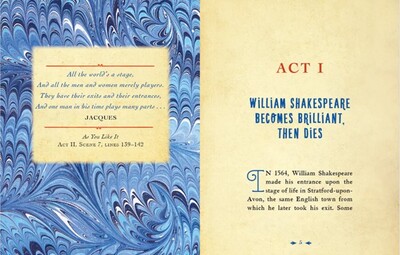
Interior from The Bard and the Book. Text © 2024 by Ann Bausum illustrations © 2024 by Marta Sevilla. Used with permission from Peachtree Publishing Company Inc.
The colorful marbled-paper borders used throughout the book are photographic images similar to handmade sheets from the eighteenth and nineteenth centuries; they are reminiscent of materials used when copies of the First Folio received new bindings during that period. The original sheets were made by suspending various colors of ink on a liquid surface, gently combing or otherwise manipulating the colors into patterns, and then placing a sheet of paper on this surface to transfer the vibrant design.
The book was printed on a sheetfed press in DongGuan, China, using rolls of machine-made Oji Zunma paper produced in NanTong, China. After exiting the printing press the sheets were mechanically folded and gathered into coded bundles, which are now simply called signatures. (You know what those are!) This book is composed of 9 signatures, which were section sewn in 12 pages for 8 signatures and 16 pages for 1 signature for a total of 112 pages.
Human hands guided this and all other steps in the production process, with the publisher's director of production and manufacturing, Melanie McMahon Ives, coordinating all phases of the operation. Completed books were boxed and shipped by ocean freighter to distribution points in the United States and beyond. Publicists and marketing representatives have promoted interest in this book through social media, advertising, and one-on-one conversations with librarians and booksellers. Copies are being stocked with online retailers, storefront chains, and at independent bookshops reminiscent of those that sold the First Folio beginning in 1623 (but with a greater diversity of beverages and snacks).
One thing hasn't changed. When you open the book, you still turn the pages by hand (even if you are viewing it electronically), and enjoy its contents with your eyes. Doodling remains optional.
-
The Magic, Mystery, and History
of
Shakespeare's First FolioA program for children grades 5 and up
Also suitable for adults and family audiences
By Ann BausumDescription: Where would we be without Shakespeare's First Folio?!! We might have less homework, it's true, but we'd also find considerably less magic in the world—and miss out on a whole lot of memorable sayings!
Beware the Ides of March. . .you beetle-headed, flap-eared knave!
This program introduces the remarkable story of the preservation of the plays of William Shakespeare in 1623 thanks to the first book devoted entirely to a collection of someone's dramatic works. The presentation includes a thought experiment of what could have been lost without the First Folio and a celebration of all that was saved. Loaded with historical illustrations and other surprises, including, of course, a pop quiz to test your knowledge of famous lines from Shakespeare.
Suggested length: About 35 minutes for program and 15 minutes for discussion
Technical requirements: LCD projector, projection screen, microphone (depending on setting)
Virtual option: This program may be requested as a virtual presentation.
Audience feedback on this program:
"Interaction with the students was great!"
—K–8 school librarian, Wisconsin"Ann brought a great energy to her study of the First Folio! She contextualized the time of Shakespeare and connected students to the language in a very engaging way."
—Middle school librarian, Wisconsin"This presentation. . .kept the interest amazingly well of a room full of third graders. . . .Bringing the masks and crown to try on was very good to really bring it to life. I would recommend this presentation to students of all ages. It was tremendous!"
—Host for student audience, South Dakota Festival of Books"I learned so much about Shakespeare, his plays, and his importance to our language—and in a very entertaining way. Ann Bausum's book may have been written for students, but it and the presentation have reignited my interest in the Bard. . . .Very good use of humor."
—Host for adult audience, South Dakota Festival of Books -
"After William Shakespeare's death, in 1616, several friends and coworkers at the theater made the farsighted decision...to preserve his work for future generations. This was a radical idea, yet Bausum states that without it, half the plays might not have survived for four centuries....Whether explaining how the era's printing presses worked or introducing the Folger Shakespeare Library, Bausum uses a fresh, reader-friendly tone, neither writing down to middle-school students nor expecting them to have prior knowledge of Shakespeare, his times, or his literary legacy....A beautiful, well-researched book exploring an intriguing subject."
—Booklist, starred review
January 1, 2024"Via friendly and humorous text...Bausum...breaks down the lucky confluence of events that led to the preservation of plays by William Shakespeare....Employing detailed scholarship, the author packs this slim volume with intriguing facts...emphasized through varying typefaces, strategic line breaks, and asides. Interspersed throughout are folk art-inspired illustrations by Sevilla....Bausum's passion for the topic is infectious, making for a joyous and engaging read for Shakespearean enthusiasts and skeptics alike. Extensive notes conclude."
—Publishers Weekly, starred review
January 25, 2024"'. . .you have been misled to think that a dead poet with an earring from more than four hundred years ago has nothing to offer you.' So says the opening lines of this truly unique collection of lost history dedicated to William Shakespeare and his famous plays. . . .This craftily written behind-the-scenes look is the perfect introduction. . . .Bausum's passion for history and its impact on generations of readers is infectious. She provides a lively nonfiction read on an intriguing subject, especially for Shakespeare aficionados—but it does not ignore the skeptics as she artfully threads Shakespearean notions together, providing a humorous glimpse into a period of time that spotlights a literary turning point. Sevilla splashes the pages with bold, colorful, unconventional visuals. . . . VERDICT. . .this is a sharply funny, delightful must-have for every library shelf."
—School Library Journal, starred review
June 1, 2024"An introduction to the most important book in the history of theater. Bausum focuses on the miracle that so many of Shakespeare's brilliant plays were preserved and explores how that came to happen. An airy rush of narrative is enlivened with quoted lines, plus photos of contemporary printed pages as well as spot art....Bausum's closing account of personal experiences at the Folger Shakespeare Library are rapturous enough to tempt like visits. A timely and engaging celebration of a literary landmark. (additional citations, source notes, bibliography, index)"
—Kirkus
February 1, 2024"This lively nonfiction work introduces young readers to both the First Folio and how Shakespeare's plays were preserved....Fun facts about early print culture...give middle grade readers a fascinating look at early modern practices of reading and writing. Bausum consistently threads the needle with winking humor and real interest....the book strikes a good balance between respecting laborious early modern work and using humor to connect with a potentially skeptical contemporary audience. Sevilla's illustrative flair complements the book's educational contents....Typography and layouts similarly serve to set the stage....Backmatter is impressively compiled, including a lovely catalog of First Folio contents...."
—Bulletin of the Center for Children's Books
February 2024". . .A captivating account details how the works of William Shakespeare were saved from obscurity thanks to the First Folio. . . .The spirited narrative touches briefly on the life and work of Shakespeare, and practices in Elizabethan theater that clarify why there weren't handwritten editions of each play to draw upon, before describing efforts that likely went into creating the First Folio. . . .The author's fascination with her subject shines. . . .Appealing design elements include large font, diagrams, photographs of artifacts, and whimsical spot art. A marvelous author's note, source notes, and more follow the closing curtain."
—Cooperative Children's Book Center
Book of the Week, May 6, 2024". . .With easy to follow overviews of various historical facts and book processes. . .made even more engaging by lovely illustrations by Sevilla and top notch book design, this book told me everything I needed to know about Shakespeare's world. . . .a fascinating book along the lines of Bryant and Sweet's Roget and His Thesaurus. . . .I will purchase it because it is an appealing, small book along the lines of Schanzer's 2011 Witches! that my students will pick up for fun, OR to look smart because they are reading about Shakespeare. I would also buy this for high school because of the extensive source notes, which I could see be very helpful for research. "
—Ms. Yingling Reads
April 23, 2024 -
Starred reviews
Booklist
Publishers Weekly
School Library JournalGold Standard Selection of the Junior Library Guild
Publishers Weekly Best Books of the Year, 2024
Kirkus Best Middle Grade Books of the Year, 2024
School Library Journal Best Books of the Year, 2024
Publishers Weekly Holiday Gift Guide, 2024
Choices 2025
Cooperative Children's Book Center, University of WisconsinDogwood Reading List
Missouri Association of School Librarians, Final Recommended Titles, 2025Beehive Book Awards
Children's Literature Association of Utah, 2026 nominee -
American Players Theatre
The author's home away from home for Shakespeare and more, nestled in the woods near Spring Green, Wisconsin.The Bodleian First Folio
A digital facsimile of a First Folio copy from the Bodleian Library, Oxford, England.Do-it-yourself First Folio and Virtual Printing House
A hands-on virtual workshop where users organize sheets for printing quires.The First Folio at the Folger
The history, the book, and other resources from the Folger Shakespeare Library.Folger Shakespeare Library
As conceived by Henry and Emily Folger and dedicated in 1932 in Washington, DC.Folio400
Celebrating the history of the First Folio and its 400th birthday in 2023.The Royal Shakespeare Company
The Bard's hometown stage, established in 1875 at Stratford-upon-Avon, England.Shakespeare at the Folger
A gateway to all things Shakespeare and more through the Folger Shakespeare Library.Shakespeare's Globe
Inspired by the original, this replica theater sits on the banks of the Thames in London, just where it ought to be.William Shakespeare's Complete Works
The first digitized archive of Shakespeare's plays and poetry, courtesy of Massachusetts Institute of Technology, Cambridge, Massachusetts. -
• The Bard and The Book: How the First Folio Saved the Plays of William Shakespeare from Oblivion
• Publication date: April 2, 2024
• Peachtree Publishing
• $19.99
• 112 pages, hardcover
• Ages 10 and up, grades 5 and up
• Illustrated by Marta Sevilla
• Additional archival images
• Back matter includes contents of the First Folio, author's note, research notes and acknowledgments, essay "The Making of THIS Book," citations, source notes, bibliography, additional resources, index
• ISBN 978-1-68263-495-0
• Audio edition available from Listening Library