EXPLORE
Behind the scenes—GROWING UP WITH THE LOST CAUSE
EDUCATOR'S GUIDE FROM THE PUBLISHER (PDF FILE)


-
WARNING:
THIS IS NOT YOUR AVERAGE U.S. HISTORY BOOK.
When the Civil War ended, the Confederates may have laid down their arms, but they were far from accepting defeat. Instead, they distorted the facts about what had happened, creating an alternate version of history. This false narrative is known as the Lost Cause.
SOME LIES OF THE LOST CAUSE:
• Slavery was a compassionate institution.
• The Civil War wasn't fought over slavery; it was all about states' rights.
• The Ku Klux Klan nobly protected Whites during Reconstruction.
These lies still influence textbooks, pop culture, public policy, and more—often in hidden and surprising ways. This book will address twenty lies of the Lost Cause and set the record straight. Dive in to learn the true history of the Civil War and its complex, far-reaching aftermath.
ARE YOU READY TO BEGIN?
-
I know a thing or two about White lies, having been raised on them in the 1960s during my childhood in Virginia. Of course, no one called them lies then.
They called them history.
So begins the Introduction for White Lies.
This text sets the scene for the history that follows. Over the course of twenty chapters, the book tracks the prolonged use of lies and half-truths to manipulate the general public in order to fuel white supremacy in the South and beyond. Sidebars profile twenty lies associated with this effort, which is collectively known as the Lost Cause.
At the end of White Lies, I include more details in my author's note about growing up surrounded by symbols and stories tied to the Lost Cause. I'm sharing that content here to illustrate the power of the Lost Cause and the potential for redemption that can follow its unmasking.

My 4th grade school photo.
I was born in the South at the middle of the last century. This circumstance, as readers will now understand, means that I was raised on the Lost Cause. My training took place at what was arguably the epicenter of Confederate commemoration: Lexington, Virginia. We moved to Lexington when I was six years old and about to enter second grade. My father had taken a post there as a professor of European history at the Virginia Military Institute, and for the rest of my childhood we lived on the post, or campus grounds.
I literally walked through history to get to and from school, first crossing ground that would have been covered by Stonewall Jackson and, depending on my grade level, traversing the campus that had been frequented by Robert E. Lee. After school, I might stop on the way home to visit the Lee Chapel, gaze at the imposing recumbent statue created by Edward Valentine, and chat with the docents who, in retrospect, were almost undoubtedly allied in some fashion with the United Daughters of the Confederacy.
My dad's campus held the greatest attraction, though: the mounted remains of Stonewall Jackson's horse, Little Sorrel. Countless times I descended into the basement of Jackson Chapel and walked to the "paddock" where Little Sorrel "grazed." I didn't really expect the horse to return to life, but with a little magic, he looked ready to step beyond the fence and take me for a ride. At the very least he took me back in time.
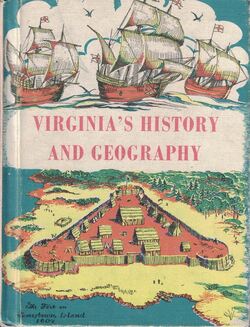
My fourth-grade textbook
Let me be clear that my education in the Confederacy was not confined to after-school meandering. Because I attended Virginia's public schools in the 1960s, I received a thorough indoctrination in Lost Cause propaganda through its state-sponsored schoolbooks. Lies oozed with an oily ease from my fourth-grade text, Virginia's History and Geography.
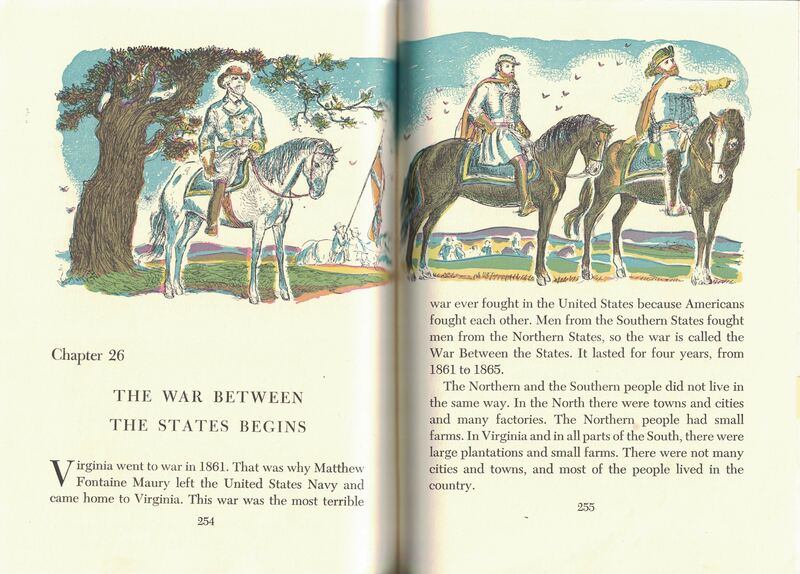
Sample pages from Virginia's History and Geography
I found the stories irresistible, particularly since they aligned so well with the landmarks that surrounded me.
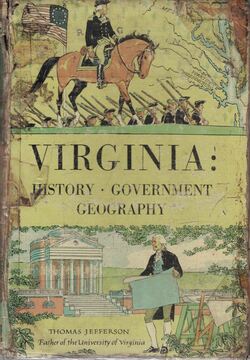
My seventh-grade textbook
In seventh grade, my classmates and I received our second dose of state history, Virginia: History, Government, Geography. This text presented the same deceptive themes as before, but with more words and fewer pictures. Both books could have been written by the United Daughters of the Confederacy. In fact, in one way or another, they basically were. (I left the district before I could study the high school text of this Lost Cause trilogy, but that didn't matter: I'd already been thoroughly indoctrinated in its tenets.)
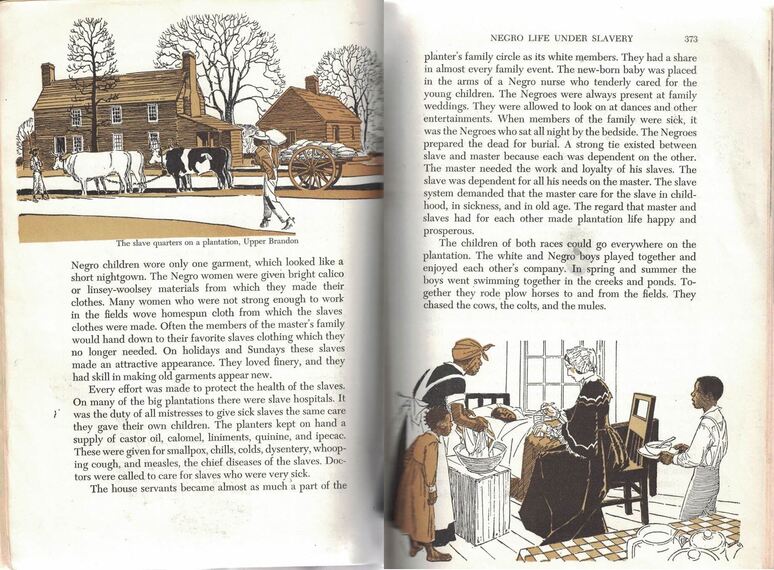
Sample pages from Virginia: History, Government, Geography
Lexington's two college campuses were my childhood playgrounds. I rollerskated past buildings that were considered national landmarks, stood mesmerized before the affecting figure crafted by Moses Ezekiel titled Virginia Mourning Her Dead, and spied on VMI cadets when they crossed the grounds of the neighboring university to see if they really would salute when they passed Lee Chapel, as they were required to do (both then and well into the twenty-first century). In 1971, the year I turned thirteen, Gone with the Wind was rereleased, and I was among those who sat enthralled in Lexington's darkened State Theater to watch the four-hour epic. Afterward, I promptly inhaled the novel.
Yes, there can be no doubt: I was most definitely raised on the Lost Cause.
Years later, after I'd begun my undergraduate education at Beloit College in Wisconsin, I returned to Lexington for a semester and enrolled in a course at Washington and Lee University. That class remains one of my undergraduate favorites. The subject was architectural history, and my professor was Pamela H. Simpson. Decades later, this gifted educator coedited with Cynthia Mills one of the sources I used in my research, Monuments to the Lost Cause. It is indeed a small world.
It took years for my world to grow big enough for me to see that my childhood had been anchored by lies. Leaving the South helped. So did returning, as I did in 2004 while researching Freedom Riders. That trip taught me something I'd never realized before: Confederate statues weren't just located in Lexington; they had been sprinkled throughout the South. Subsequent research trips, particularly for The March Against Fear, reinforced that discovery. The reading I did for these and other books I've written about social justice history taught me what I'd never learned in school: Our national story is darker, richer, and more complex than anything I'd previously been led to believe.
And it is a national story worth sharing.
White Lies is not just my contribution to correcting that historical record, although that's certainly one aim. And it is not just my effort to liberate readers from propaganda that diminishes our understanding of history. This book marks a personal journey to make myself a little bit more whole, to wash clean some of the fabrications that burrowed into my brain, and to find ways to love again a city and a part of the country that I had ceased to understand. Finally, this book represents my humble effort to right not just the wrongs that were imposed on me but to atone for those that have been imposed on all of us.
May we grow stronger and create a better nation by exploring this ground together.
-
A History of Lies
A program for teens and adults
by Ann BausumDescription: What happens when history becomes lies? What happens when propaganda is presented as history? This examination of the Lost Cause from post-Civil War America captures the stakes. We'll trace the origins and impact of multiple lies from this pro-white narrative, including:
• Slavery was a compassionate institution,
• The Civil War wasn't fought over slavery, and
• We erase history when we remove symbols of the Confederacy.
The program includes examples from the author's childhood history texts of Lost Cause content from the 1960s. We'll consider how lies can take hold as "the truth." As a bonus, we'll examine some of the most common Lost Cause-inspired defenses of Confederate commemoration and break down their flaws.
Save plenty of time for discussion. The power of propaganda is a high-interest topic.
Suggested length: Program length 40 minutes followed by 15-20 minutes for discussion
Technical requirements: LCD projector, projection screen, microphone (depending on setting)
Virtual option: This program may be requested as a virtual presentation.
Audience feedback on a related program:
"This was a powerful and salient topic! I loved how you showed your textbooks from childhood—that was very powerful.…The slides were well organized, engaging, and highlighted in just the right spots for emphasis. Thank you for sharing your meticulous research."
—Program attendee, Provo, Utah -
"A narrative of how the famed Lost Cause mythology took hold after the U.S. Civil War. Noted nonfiction author Bausum seeks to answer the question: If history is written by the victors, how did the defeated Confederates' viewpoint end up becoming the dominant perspective?…[C]hapters are punctuated by sidebars covering Confederate statues ('Gallery of the Lost Cause') and debunking 20 foundational lies of the romanticized Lost Cause.…Bausum counters the lies with direct quotes from key Confederate leaders and Lost Cause thought leaders, demonstrating how impossible it is to decouple the Confederate cause from racism and slavery. The clear, direct prose shuns euphemisms, explicitly naming obfuscating language.…The dispassionate tone results in an authoritative voice, supported by extensive research, that avoids sensationalism. The conclusion encourages readers to reject falsehoods disguised as patriotism, learn from the past, and 'better the world.' Essential reading. (language note, author's note, research notes, timeline, source notes, bibliography, image credits, index)"
—Kirkus, starred review
June 15, 2025"…The story of the 'Lost Cause' of the Confederacy recasts Southern rebels as heroes and patriots, responsible citizens who were merely fighting against the overreach of the federal government and decidedly not for their ability to maintain their economic wealth on enslaved labor.…Clear-eyed and merciless, Bausum defines and then thoroughly dismantles twenty lies that buttressed the false story of the Lost Cause, showing how the twisted logic was codified in legislation and permeated education and culture, devastating Reconstruction efforts and setting the stage for decades of systemic oppression of Black people by an unrelentingly racist society.…Monuments honoring the Lost Cause are a running presence through the book…and the final section tackles the ongoing argument around the statues and how they continue to perpetuate the destructive myth. The book as a whole leaves readers with little doubt that Southern claims of noble heritage are nothing more than a losing side's self-soothing insistence that they won a war on a moral high ground even if they failed on the battlefield. Meticulously researched…this is a must-have in the history classroom and beyond."
—Bulletin of the Center for Children's Books, starred review
June 2025"An insightful and complex volume reviewing 20 foundational lies used by white supremacists to justify the enslavement and post–Civil War subjugation of African Americans. Broken down into four historical periods, from the antebellum period through current day, the work outlines five lies from each time frame, each with an in-depth chapter that discusses prominent individuals and organizations along with their actions to perpetuate these lies. She highlights how these lies are interjected into popular literature and the cinema, academia, the military, and the more well-known governmental laws and regulations of Jim Crow.…It all makes for necessary reading. Detailed research is evident with extensive back matter including a time line, source notes, and bibliography (index not seen). VERDICT An important and compelling work that belongs in all high school and public libraries."
—School Library Journal, starred review
July 2025"In this searing account, Bausum.… [employing] frank text outlines the buildup to and aftermath of the war, the language used to establish the foundational principles of the Lost Cause, the effect that widespread dissemination of these ideologies has had on future generations, and America's reckoning with whether ‘its national story [should] be told with facts or as propaganda.'…Throughout, Bausum notes how the Lost Cause impacted public policy (Jim Crow laws), popular culture (Gone with the Wind), and education. Collage-like spreads comprised of archival photographs and news clippings highlight key players of the era, and direct quotations from prominent Confederate leaders are featured throughout, helping to further aid in the work's debunking of romanticized depictions of the titular war. It's an essential and powerful offering that encourages readers to critically engage with historical record and to use the knowledge they obtain ‘to better the world.'"
—Publishers Weekly, starred review
July 14, 2025"‘Slavery was a compassionate institution' and ‘The Civil War wasn't fought over slavery; it was all about states' rights' are 2 of the 20 lies debunked in this enlightening study of how former Confederates and powerful white Southerners framed the narrative of the Civil War and its aftermath.…Bausum divides the book into four sections that combine facts and clear, engaging explanations with true stories to help dismantle misinformation surrounding slavery and racism in the U.S. The first part describes how enslaved people became the nation's dominant infrastructure.… The second section presents the origins of the Lost Cause and its core tenets.… The third part shows the rise of Lost Cause propaganda disguised as history through monuments, Hollywood films, books, and even public school education. The final section considers racism today and recent endeavors to restore historical accuracy. A clear explanation of terminology and language used prefaces the book, which also features archival images, "Gallery of the Lost Cause" monument spotlights, an annotated time line, and copious source notes. An essential volume to understand the history of racial division in the U.S."
—Booklist, starred review
August 1, 2025"‘For more than a century and a half, a tsunami of Confederate commemoration has washed over the United States of America. So have its associated lies.' Bausum lists these falsehoods of the Lost Cause (‘part of a deliberate pattern of misinformation' perpetuated by Confederates and their sympathizers) and then dismantles them one by one in this extensively researched book. Her work confronts twenty different lies, including that the Civil War was about states' rights, not slavery, and that the Ku Klux Klan was a noble organization. Bausum's short chapters and clear language help teen readers understand complex subjects and make connections between lies that started in the mid- to late nineteenth century and societal ills that still plague the United States today. She also provides information about lingering Confederate symbols.…Bausum appeals to readers to learn from the nation's past mistakes and ‘use that knowledge to better the world.'…"
—Horn Book Magazine, starred review
September/October 2025"Ann Bausum…intends to set the record straight about the War of the Rebellion (i.e. the Civil War), its cause, and its aftermath.…Bausum employs extensive research to systematically dissect and debunk the falsehoods that created the Lost Cause narrative, a story that continues to endanger lives in the United States more than 100 years later. The book is structured around 20 major deceptions, or ‘white lies'; each begins a chapter and provides the section's foundation and content.…At the heart of all the fabrications is the subject of slavery, the true cause of the Civil War. While many insist the cause was ‘states' rights,' Bausum proves this to be one of the largest white lies: ‘Before the war began, countless White southerners had spoken out repeatedly in support of both slavery and secession. They believed they could only preserve the one by undertaking the other.' And as Bausum explains, ‘Americans continue to be misled about basic facts of U.S. history because of the states' rights lie.' …an accessible and enthralling work of nonfiction… "
—Shelf Awareness, starred review
August 22, 2025 -
Seven starred reviews
Booklist
Bulletin of the Center for Children's Books
Horn Book Magazine
Kirkus
Publishers Weekly
School Library Journal
Shelf AwarenessYALSA 2026 Excellence in Nonfiction Award Finalist
American Library AssociationGolden Kite Award
Nonfiction text for older readers, 2026
Society of Children’s Book Writers and IllustratorsBooklist Editors' Choice 2025
Fanfare 2025 Booklist, Horn Book Magazine
Kirkus Best Books of the Year, 2025
New York Public Library's Best Books of 2025
School Library Journal Best Books of the Year, 2025
Shelf Awareness Best Books of the Year, 2025
Washington Post Best New Books for Fall, 2025
-
American Historical Association
Supporting history and the work of historiansBlack-American Members by Congress
Online exhibit hosted by United States House of RepresentativesThe Civil War in America
Library of Congress exhibition featuring primary source documentsConfederate Veteran
Online archive for monthly magazine, published 1893–1932Fighting the Lost Cause
by Ann Bausum, The Horn Book, 2017Hatewatch
Online database of hate groups, compiled by the Southern Poverty Law CenterJim Crow Museum of Racist Imagery
A Measuring Rod to Test Text Books and Reference Books in Schools, Colleges, and Libraries
by Mildred Lewis Rutherford, 1919Monumental Bronze Co. catalog, 1882
National Monument Audit
Analysis of public memorials conducted by Monument Lab, 2021National Museum of African American History and Culture
Slave Voyages
Online database documenting the Trans-Atlantic journeys for enslaved AfricansSlaveholders in Congress
Online database compiled and analyzed by the Washington Post in 2022Smithsonian American Art Inventories Catalog (SIRIS)
U.S. Census of 1860, Introduction
U.D.C. Catechism for Children
by Cornelia Branch Stone, United Daughters of the Confederacy, 1904U.S. Naming Commission, Final Report, Part I
United States Army BasesU.S. Naming Commission, Final Report, Part II
U.S. Military Academy and U.S. Naval AcademyU.S. Naming Commission, Final Report, Part III
Remaining Department of Defense AssetsWhose Heritage? Public Symbols of the Confederacy
Online database of memorials to the Confederacy, Southern Poverty Law Center -
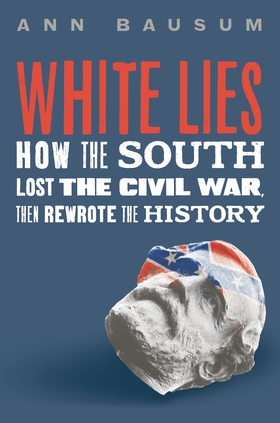
• White Lies: How the South Lost the Civil War, Then Rewrote the History
• Publication date: August 12, 2025
• Roaring Brook Press, Macmillan Publishers
• $21.99
• 368 pages, hardcover
• Ages 12–18
• Illustrated with archival and contemporary photographs
• Back matter includes Timeline, author's note, research notes and acknowledgments, source notes, bibliography, index
• ISBN 9781250816573